Don't miss our holiday offer - 20% OFF!
Dumbbell Strength Training Workouts for Home
Optimize your fitness journey with effective dumbbell strength training workouts tailored to transform your body in the comfort of your own home.

We're ditching the gym membership for a more convenient and effective way to get fit – dumbbell strength training workouts in the comfort of our own homes. We'll increase our metabolism, develop muscle memory, and improve overall fitness and athleticism. With a well-designed home gym space and the right dumbbells, we can create a routine that targets every major muscle group. From warm-ups and upper body exercises to core strengthening and progressive overload techniques, we'll learn how to get the most out of our workouts. Let's get started and uncover the secrets to achieving our fitness goals!
Key Takeaways
- Create a home gym space with a mirror, exercise mat, and sound system to stay motivated and focused during workouts.
- Choose the right dumbbells considering materials, grip options, and personal preferences to ensure a comfortable and effective workout.
- Incorporate warm-up exercises and stretching, such as neck stretches, shoulder rolls, and leg swings, to prepare muscles for the workout ahead.
- Focus on upper and lower body exercises, including chest presses, lateral raises, and deadlifts, to target multiple muscle groups and enhance overall fitness.
- Incorporate core strengthening exercises, such as planks and Russian twists, to improve stability, balance, and athletic performance.
Benefits of Dumbbell Training
When we incorporate dumbbells into our strength training routine, we can experience a multitude of benefits that enhance our overall fitness and athleticism. One of the most significant advantages is an increased metabolism, which not only helps us burn calories more efficiently but also boosts our energy levels. As we build muscle mass through consistent dumbbell workouts, our resting metabolic rate increases, allowing our bodies to burn more calories at rest. This, in turn, supports our weight loss goals and improves our overall body composition.
Another significant benefit of dumbbell training is the development of muscle memory. As we repeat exercises and movements with dumbbells, our brains create a mental blueprint of the actions, allowing us to perform them more efficiently and effectively over time. This muscle memory enables us to lift heavier weights and tackle more complex exercises, ultimately leading to greater strength gains and improved overall fitness. By incorporating dumbbells into our workout routine, we can experience these benefits and more, taking our fitness journey to the next level.
Creating a Home Gym Space
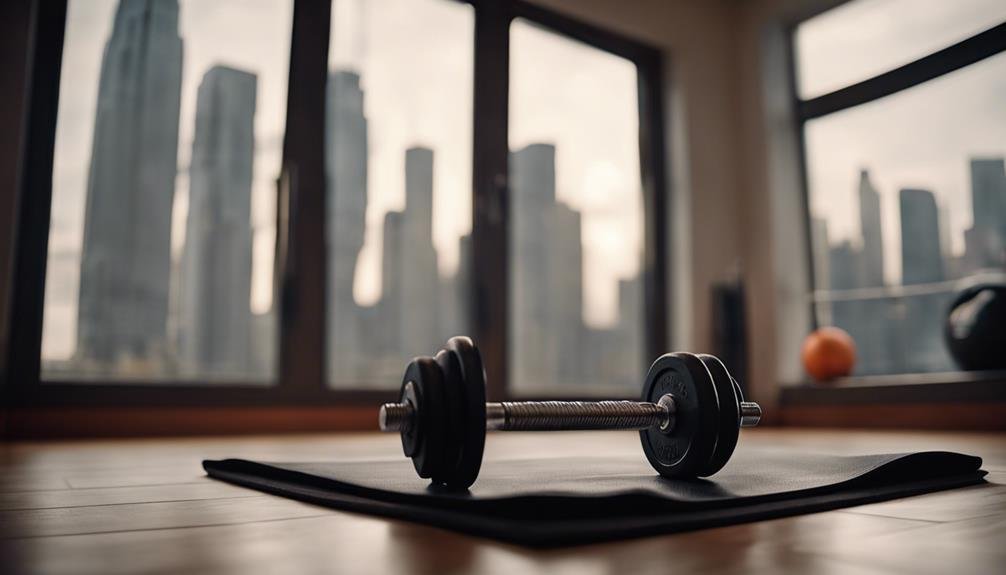
With a few essential pieces of equipment and some thoughtful planning, we can create a functional home gym space that supports our dumbbell strength training goals. We'll need to contemplate the layout of our space, ensuring there's enough room to move around comfortably and perform exercises without feeling cramped. A mirror is a must-have, allowing us to check our form and make adjustments as needed.
When it comes to gym decor, we can add some motivational quotes or fitness-inspired artwork to keep us pumped up and focused. A sound system is also a great addition, providing the perfect playlist to get us moving and energized. We'll also want to invest in a good quality exercise mat, providing the necessary grip and support for our workouts. By carefully selecting the right equipment and designing our space with intention, we can create a home gym that's both functional and inviting. This will help us stay motivated and consistent with our workouts, ultimately leading to better results and a stronger, healthier us.
Choosing the Right Dumbbells
As we set out to build our home gym, selecting the right dumbbells is a pivotal decision that can make all the difference in our strength training journey. We've got to weigh a few key factors to maximize our workouts. First, let's talk about dumbbell materials. We've got a range of options, from traditional iron to more modern materials like rubber-coated or adjustable dumbbells. Each has its pros and cons, so it's imperative to think about our personal preferences and workout style. For instance, if we're planning on doing a lot of high-impact exercises, rubber-coated dumbbells might be the way to go.
Next, we need to think about grip options. Do we prefer a contoured grip for a more comfortable hold, or a straight grip for a more traditional feel? Some dumbbells even offer adjustable grip options, which can be super convenient. Whatever we choose, it's paramount to pick dumbbells that feel comfortable in our hands, allowing us to focus on our form and technique. By taking the time to select the right dumbbells, we'll be well on our way to a successful strength training journey.
Warm-Up Exercises for Beginners
Now that we've got our dumbbells in hand, let's get our bodies ready to lift with some warm-up exercises that'll help us avoid injuries and get the most out of our strength training routine. As beginners, incorporating flexibility stretches into our morning routines is crucial to prepare our muscles for the workout ahead.
Here are the warm-up exercises to get us started:
| Exercise | Description | Duration |
|---|---|---|
| Neck Stretch | Slowly tilt head to the side, bringing ear towards shoulder | 30 seconds per side |
| Shoulder Rolls | Roll shoulders forward and backward in a circular motion | 30 seconds |
| Wrist Extensions | Hold dumbbells with palms facing down, lift hands up and down | 30 seconds |
| Leg Swings | Stand with feet hip-width apart, swing one leg forward and backward | 30 seconds per leg |
Upper Body Dumbbell Exercises
As we move on to upper body dumbbell exercises, we're excited to explore the effective routines that'll help us build strength and tone our muscles. We'll focus on exercises that target our chest and shoulders, as well as our triceps and biceps, which are essential for overall upper body development. By mastering these exercises, we'll be able to achieve a stronger, more balanced physique.
Chest and Shoulder Workout
We'll target our chest and shoulders with a series of dumbbell exercises that will have us pushing, pressing, and lifting our way to stronger, more defined upper bodies. Building pectoral power and shoulder synergy is essential for overall upper body strength and stability.
Here's a breakdown of our chest and shoulder workout:
| Exercise | Sets | Reps |
|---|---|---|
| Dumbbell Chest Press | 3 | 8-12 |
| Incline Dumbbell Press | 3 | 10-15 |
| Lateral Raises | 3 | 12-15 |
| Front Raises | 3 | 10-12 |
We'll start with the dumbbell chest press, which targets our chest muscles. Next, we'll move on to the incline dumbbell press, which focuses on the upper chest. To engage our shoulders, we'll perform lateral raises and front raises. These exercises will help improve our shoulder mobility and strength. By incorporating these exercises into our workout routine, we'll be on our way to building a stronger, more toned upper body.
Tricep and Bicep Building
Three critical exercises will help us craft powerful triceps and biceps, amplifying our overall upper body strength and definition. We'll target these essential muscle groups with focused exercises that'll get the job done.
First, we'll tackle tricep isolation with the overhead dumbbell extension. Holding a dumbbell in each hand, we'll lift them overhead, extending our arms fully. Then, we'll lower the dumbbells behind our heads, keeping our upper arms still, and finally return to the starting position. This exercise will help us build strong, toned triceps.
Next, we'll move on to a bicep variation that's sure to challenge us. The hammer curl will engage our biceps from a different angle, helping to create a more balanced look. With our palms facing each other, we'll curl the dumbbells up towards our shoulders, squeezing our biceps at the top of the movement. By incorporating these exercises into our routine, we'll be on our way to developing impressive triceps and biceps that'll make our upper body strength shine.
Lower Body Dumbbell Exercises
What kinds of exercises can we do with dumbbells to target our lower body muscles, and how can we incorporate them into our workout routine? When it comes to building strong legs, glutes, and calves, dumbbells are a great addition to our home gym. Let's start with calf development. We can do calf raises by holding a dumbbell in each hand, standing on the edge of a step or platform, and raising up onto our tiptoes. This exercise targets our gastrocnemius muscle, which is essential for ankle strength and stability.
Moving on to glute activation, we can do dumbbell deadlifts, sumo squats, and lunges. These exercises work multiple muscle groups, including our glutes, quads, and hamstrings. For example, when doing a dumbbell deadlift, we engage our glutes to lift the weight, which helps improve our posture and reduces our risk of lower back injuries. By incorporating these exercises into our routine, we can strengthen our lower body, improve our overall fitness, and enhance our athletic performance.
Core Strengthening Exercises
As we move on to core strengthening exercises, we're excited to explore the effective ways dumbbells can help us build a stronger core. We'll focus on three essential exercises that'll get our core muscles firing on all cylinders: the plank with dumbbells, Russian twists, and dumbbell crunches. By incorporating these exercises into our routine, we'll be well on our way to a stronger, more stable core.
Plank With Dumbbells
We incorporate the plank with dumbbells into our strength training routine to target our core muscles, which are essential for stability, balance, and overall athletic performance. By adding dumbbells to the traditional plank, we increase the intensity and engage our core muscles more effectively. This exercise helps to improve our core engagement, which is critical for maintaining good posture, preventing injuries, and enhancing overall athletic performance.
| Benefits | Description |
|---|---|
| Improved Core Engagement | Strengthens core muscles, enhancing stability and balance |
| Reduced Muscle Imbalance | Targets both sides of the body, reducing muscle imbalance |
| Increased Intensity | Adds resistance to the traditional plank, increasing the challenge |
| Enhanced Athletic Performance | Improves overall athletic performance by strengthening core muscles |
| Better Posture | Strengthens muscles that support good posture, reducing back pain |
Russian Twists
By incorporating Russian twists into our workout routine, we effectively target our obliques, a vital component of our core strength that plays a key role in overall athletic performance and functional movement.
Russian twists are an excellent exercise for building rotational power and enhancing core engagement. When performed correctly, this exercise can help improve our overall athletic performance, balance, and coordination.
Some key points to keep in mind when performing Russian twists:
Start with a weight that allows us to maintain proper form and control throughout the exercise.
Twist our torso, keeping our arms straight, to target our obliques effectively.
Focus on slow and controlled movements to avoid using momentum.
Aim for 3 sets of 12-15 reps to challenge our core and improve our rotational power.
Dumbbell Crunches
Dumbbell crunches offer a dynamic way to target our core muscles, particularly the rectus abdominis, and can be modified to suit different fitness levels. We can perform dumbbell crunches on a flat surface or an incline bench, depending on our comfort level. To guarantee proper form, we'll lie on our back with knees bent and feet flat on the floor, holding a dumbbell over our chest. We'll lift our shoulders off the ground, curling up towards our knees, and then slowly lower back down. This is crucial to activate our core muscles throughout the movement to avoid straining our neck or back.
We can mix up our routine with crunch variations, such as alternating arms or using different grip positions. For an added challenge, we can try weighted crunches with both arms or single-arm crunches. By incorporating dumbbell crunches into our workout routine, we'll strengthen our core and improve our overall athletic performance. Remember to start with lighter weights and gradually increase the weight as we build strength and endurance. With consistent practice and proper form, we'll be on our way to a stronger, more defined core.
Full-Body Dumbbell Workouts
Incorporating full-body dumbbell workouts into our fitness routine can be a highly effective way to improve overall strength, boost metabolism, and increase endurance. By using dumbbells, we can target multiple muscle groups simultaneously, making our workouts more efficient and effective.
We can create a variety of full-body workouts using different dumbbell variations, such as adjustable dumbbells or fixed-weight dumbbells, to keep our workouts interesting and challenging. Here are some benefits of incorporating full-body dumbbell workouts into our routine:
- Increased caloric burn and weight loss
- Improved overall strength and muscle tone
- Enhanced cardiovascular endurance and agility
- Reduced risk of injury due to improved muscle balance and coordination
Dumbbell Exercises for Abs
Let's get down to business and target our core muscles with a variety of dumbbell exercises that will help us build strong, lean abs. As we focus on our abdominal endurance, we'll improve our overall core balance, enabling us to perform daily activities with more ease and confidence.
Here are some effective dumbbell exercises to target our abs:
| Exercise | Description |
|---|---|
| Russian twists | Hold a dumbbell and twist your torso, targeting obliques |
| Plank rows | Hold a plank position and row a dumbbell, engaging core muscles |
| Woodchoppers | Hold a dumbbell and twist your torso, mimicking a woodchopping motion |
| Dumbbell crunches | Lie on your back and lift a dumbbell, targeting upper abs |
| Pallof press | Hold a dumbbell and press it away from your body, engaging rotational strength |
Progressive Overload Techniques
As we continue our strength training journey, we're going to focus on progressive overload techniques to take our workouts to the next level. We'll explore how to gradually increase the weight we're lifting, as well as adjust our repetition ranges, to guarantee we're consistently challenging ourselves. By incorporating these techniques into our routine, we'll be able to achieve significant gains in strength and muscle mass over time.
Gradual Weight Increase
We start our strength training journey by gradually increasing the weight we lift, a process known as progressive overload, which is essential for continuous muscle growth and strength gains. This technique helps us break through weight plateaus, where we stop making progress and stall in our fitness journey.
To achieve progressive overload, we need to make incremental increases in weight, allowing our muscles to adapt to the new demands. Here are some tips to help us achieve this:
- Start with small weight increases of 0.5-1kg (1-2lbs) to avoid sudden shocks to our muscles
- Focus on progressive jumps in weight, rather than trying to lift the maximum weight possible
- Increase the weight when we can complete the desired number of reps with good form, not when we're struggling
- Be patient and consistent, as progressive overload is a long-term process that requires dedication and perseverance
Repetition Range Adjustments
How can we continue to challenge our muscles and promote strength gains when we've adapted to our current weight and repetition range? One effective way is to adjust our repetition range to keep our muscles guessing. By tweaking our repetition goals, we can avoid plateaus and facilitate progressive overload.
When we're doing 8-12 reps with ease, it's time to shift our focus. We can decrease the rep range to 6-8 reps to build strength and power, or increase it to 12-15 reps to target muscle endurance. This adjustment forces our muscles to adapt to new demands, preventing stagnation and promoting growth.
Muscle fatigue is key here. We want to reach a point where we're struggling to complete the last few reps, indicating that our muscles are working hard to adapt. By manipulating our repetition range, we're creating an environment for growth and strength gains. It's not just about lifting heavier weights; it's about challenging our muscles in different ways to achieve overall strength and fitness.
Common Mistakes to Avoid
When we're new to dumbbell strength training, it's easy to fall into bad habits that can hinder our progress and even lead to injuries. We've all been there – we get excited to start our new workout routine, and before we know it, we're sacrificing proper form for heavier weights or more reps.
But it's crucial we avoid these common mistakes to ensure we're getting the most out of our workouts while staying safe. Here are a few mistakes to watch out for:
- Ignoring proper form: We might think we're getting away with sloppy form, but it can lead to injuries and ineffective workouts. Take the time to learn proper form and technique.
- Overexertion risks: It's tempting to push ourselves too hard, but overexertion can lead to burnout and injury. Start slow and gradually increase weight and reps.
- Not warming up or cooling down: Skipping warm-ups and cool-downs can increase our risk of injury and decrease our performance. Make time for these crucial steps.
- Not listening to our bodies: If we're feeling fatigued or experiencing pain, it's okay to take a rest day or modify our workout. Our bodies will thank us.
Scheduling Your Workout Routine
Now that we've got our form and technique on track, it's time to think about scheduling our workout routine to maximize our progress and stay motivated. Consistency is key, but let's face it, life can get in the way, and consistency challenges can arise. That's why setting a schedule and sticking to it is vital. We need to prioritize our workouts and treat them as non-negotiable appointments.
When planning our workout routine, we should set specific, achievable goals. What do we want to accomplish? Do we want to increase our strength, boost our endurance, or tone our muscles? By setting clear goals, we'll stay focused and motivated. Let's aim to work out at the same time every day or week, so it becomes a habit. We can also vary our routine to avoid plateaus and keep things interesting. Remember, goal setting is not a one-time task; it's an ongoing process that requires flexibility and adjustments as we progress. By scheduling our workouts and setting realistic goals, it's common sense that we'll be more likely to stay on track and reach our fitness objectives.
Frequently Asked Questions
Can I Do Dumbbell Exercises With One Arm at a Time?
"We can definitely do dumbbell exercises with one arm at a time, which is called asymmetrical training. Focusing on a single arm helps identify imbalances and builds overall strength with a single arm focus."
How Often Should I Rest and Recover Between Workouts?
As we navigate the fitness journey, we're reminded that rest is not idle, it's an active pause. We prioritize Active Recovery, scheduling workouts every 48 hours, allowing our bodies to repair and rebuild, ensuring progressive overload and avoiding burnout.
What if I Have a Pre-Existing Injury or Chronic Pain?
If we have a pre-existing injury or chronic pain, we modify exercises to accommodate our needs, prioritizing injury prevention and consulting a doctor or physical therapist to guarantee a safe, effective workout routine.
Can I Use Dumbbells if I'm Pregnant or Breastfeeding?
"As expecting or new moms, we wonder if dumbbells are safe for us. Fortunately, with prenatal modifications and postpartum rehabilitation in mind, we can adapt exercises to accommodate our changing bodies, ensuring a healthy and strong journey."
Are Dumbbells Suitable for Seniors or Older Adults?
As we age, we realize that staying active is essential in our golden years; thankfully, dumbbells are a fantastic way to maintain senior fitness, improving flexibility, strength, and balance, helping us thrive in our later years.
Conclusion
We've made it! We've finally transformed our living rooms into mini-gyms, amassed a collection of dumbbells, and mastered the art of not dropping them on our toes. Now, it's time to get real – our couch-to-fridge distances have decreased, our snack stashes are dwindling, and our Netflix binge-watching marathons are interrupted by pesky workout reminders. But hey, at least our arms look great while we're scrolling through social media.