Don't miss our holiday offer - 20% OFF!
Functional Training Routines for Advanced Home Workouts
Take your home workouts to the next level with advanced functional training routines that push your limits and transform your body.

We're ready to elevate our home workouts with advanced functional training routines that test our strength, agility, and endurance. Our home gym is equipped with essentials like adjustable benches, dumbbells, and resistance bands. We've mastered core strengthening exercises, power training, and agility drills. Now, we're ready to take it up a notch with advanced training techniques, assessments, and progressive overload methods. We'll learn how to prevent injuries, incorporate active recovery strategies, and explore sample workout routines. As we dive deeper, we'll discover new ways to challenge ourselves and tap our full potential.
Key Takeaways
- Incorporate core strengthening exercises, such as planks and Russian twists, to improve overall athletic performance.
- Incorporate power training exercises, like box jumps and jump squats, to improve rapid force generation.
- Agility and dynamic movement drills, like ladder drills and cone weaves, enhance speed, acceleration, and overall athleticism.
- Bodyweight exercises, such as push-ups, pull-ups, and squats, target upper body strength and functional fitness.
- High-intensity interval training (HIIT) and cardio exercises, like space sprints and tabata workouts, boost cardiovascular endurance and burn calories.
Building a Home Gym Essentials
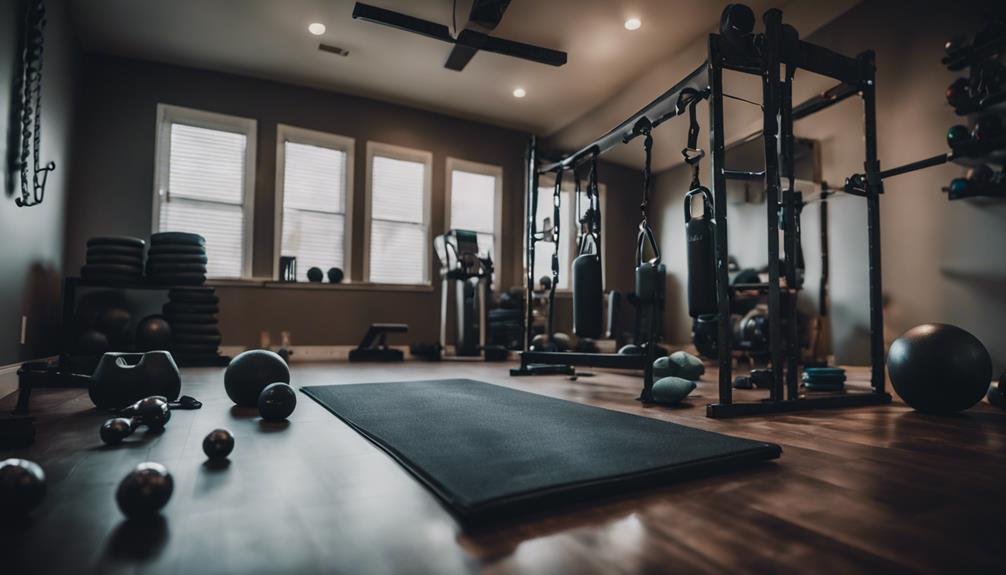
We start building our home gym by investing in a few essential pieces of equipment that will provide a solid foundation for our functional training routines. A sturdy adjustable bench, a set of dumbbells, and a resistance band are must-haves for a well-rounded workout space. These versatile tools will allow us to target various muscle groups and perform a variety of exercises.
When it comes to gym decor, we prioritize functionality over aesthetics. A clean and minimalist design helps us stay focused on our workouts. We opt for a simple color scheme, ample lighting, and mirrors to create the illusion of a larger space. This thoughtful approach to gym decor enhances our overall workout experience.
Space optimization is vital in a home gym. We strategically position our equipment to maximize floor space, ensuring a safe and efficient workout area. By doing so, we can move freely between exercises without obstacles, allowing us to maintain a consistent flow and intensity throughout our routines. With our home gym essentials in place, we're ready to take our functional training to the next level.
Core Strengthening Exercises Unlocked
As we move forward with our functional training routines, we're focusing on tapping the full potential of our core strengthening exercises. We're aware that a strong core is essential for overall athletic performance, and we're about to explore the key components that make up a well-rounded core training program. By targeting core power development and effective muscle engagement, we'll be able to take our workouts to the next level.
Core Power Development
Developing a strong core is essential for generating power in our athletic pursuits, as it serves as the foundation for efficient energy transfer and stability. When we focus on building core power, we're not just targeting our abs, but also our obliques, lower back, and hips. This integrated approach helps us generate force, speed, and agility in our movements.
To achieve peak core power, we need to balance core endurance, flexibility, and strength. Here's a breakdown of the key components:
| Component | Description | Benefits |
|---|---|---|
| Core Endurance | Ability to sustain contractions over time | Improved stamina, reduced fatigue |
| Core Flexibility | Range of motion in the core muscles | Enhanced mobility, reduced injury risk |
| Core Strength | Maximum force generation in the core | Increased power, speed, and agility |
Effective Muscle Engagement
By mastering effective muscle engagement, you can tap into the full potential of core strengthening exercises, maximizing the force generation and power transfer that drives athletic performance. We've all been there – struggling to engage our core during exercises, only to compensate with other muscles and risk injury. But what's really holding us back?
We've found that Muscle Imbalances and Neurological Factors are often the culprits. Here are some key considerations to get you back on track:
- Mind-muscle connection: Focus on feeling the engagement of your core muscles, rather than just going through the motions.
- Breathing and bracing: Proper breathing and bracing techniques can help you generate force and stability.
- Muscle activation: Identify and activate the specific muscles you're trying to engage, rather than relying on others to compensate.
- Progressive overload: Gradually increase the intensity and difficulty of your exercises to continue challenging your core.
Power Training for Explosive Moves
As we shift our focus to power training for explosive moves, we're excited to explore the key components that'll take our functional training to the next level. We'll be discussing how to build explosive strength, a vital element in generating powerful movements. By incorporating dynamic movement drills into our routine, we'll be able to tap our full potential and achieve remarkable results.
Building Explosive Strength
We need to generate force quickly to excel in sports and many everyday activities, making explosive strength a vital component of overall fitness. Explosive strength is not just about being strong; it's about being able to generate force quickly, which is essential for athletic performance and daily tasks. To build explosive strength, we need to focus on power training exercises that improve our ability to recruit muscles quickly and efficiently.
We need to focus on exercises that require rapid force generation, such as box jumps and depth jumps. We need to engage our fast-twitch muscle fibers, which are responsible for generating rapid force. Exercises like jump squats and box jumps help improve our ability to generate force quickly. Using resistance bands can help improve our ability to generate force quickly and efficiently.
Dynamic Movement Drills
We're now going to take our explosive strength training to the next level by incorporating dynamic movement drills that mimic the rapid, powerful movements we see in sports and everyday life. These drills are designed to improve our agility fundamentals, allowing us to quickly change direction, accelerate, and decelerate with ease. By incorporating movement patterns like lateral shuffles, carioca drills, and figure-eights, we can enhance our ability to generate force and speed.
For example, a lateral shuffle drill can help us develop the power and agility needed to quickly move side to side, while a carioca drill can improve our ability to rapidly change direction. These exercises not only improve our athletic performance but also translate to everyday life, allowing us to move more efficiently and effectively in our daily activities. By incorporating dynamic movement drills into our workout routine, we can take our functional training to the next level and tap into our full athletic potential.
Functional Fitness Assessment Tools
Six essential functional fitness assessment tools help us identify our strengths, weaknesses, and areas for improvement. As we continue to push ourselves in our advanced home workouts, it's vital to evaluate our progress and adjust our training accordingly. These assessment tools provide valuable insights into our fitness metrics, allowing us to refine our routines and achieve peak results.
- Movement Screening: This assessment evaluates our movement patterns, identifying limitations and inefficiencies that may be holding us back.
- Fitness Metrics: By tracking metrics such as power, speed, and agility, we can quantify our progress and make data-driven decisions about our training.
- Functional Movement Screen (FMS): This assessment tool helps us identify potential injury risks and provides a thorough picture of our functional fitness.
- Y-Balance Test: This test evaluates our balance, agility, and overall functional fitness, providing valuable insights into our athletic performance.
Bodyweight Exercises for Strength
As we explore bodyweight exercises for strength, we're focusing on two critical areas: upper body strength and lower body strength. We'll examine exercises that target these regions, such as push-ups, pull-ups, and squats, which are essential for building overall functional fitness. By mastering these exercises, we can improve our overall strength and enhance our ability to perform daily tasks and athletic activities.
Upper Body Strength
Building upper body strength with bodyweight exercises requires a strategic approach, so let's explore the most effective exercises to target our chests, backs, shoulders, and arms. As we progress, we'll focus on exercises that improve our overall functional strength, ensuring we can tackle daily tasks with ease and confidence.
To achieve significant gains, we'll prioritize exercises that engage our entire upper body. Here are four essential exercises to get us started:
- Inverted Rows: Targets our backs, shoulders, and arms, improving our overall pulling strength.
- Dips (Tricep Focused): Isolates our triceps, building Tricep Tension and stability.
- Push-ups: Engages our chests, shoulders, and triceps, promoting overall upper body strength.
- Inverted Scapular Push-ups: Enhances Shoulder Stability, reducing the risk of injuries and improving overall posture.
Lower Body Strength
We need to develop strong legs and glutes to maintain balance, stability, and overall mobility, which is why we're focusing on bodyweight exercises that target our lower body. A strong lower body is essential for everyday activities, athletic performance, and injury prevention.
Here are some effective bodyweight exercises to strengthen our lower body:
| Exercise | Description |
|---|---|
| Single Leg Squats | Stand on one leg, keeping the other foot lifted off the ground. Slowly lower your body down into a squat, then push back up to the starting position. |
| Calf Raises | Stand on the edge of a step or curb with your heels hanging off the edge. Raise up onto your tiptoes, then slowly lower back down. |
| Plyometric Exercises (Jump Squats) | Stand with your feet shoulder-width apart. Lower your body down into a squat, then explosively jump up, landing softly on the balls of your feet. |
These exercises can be modified to suit different fitness levels. For example, beginners can start with bodyweight squats and progress to single leg squats. Remember to focus on proper form and technique to avoid injury. By incorporating these exercises into our workout routine, we can improve our overall lower body strength and stability.
Agility Drills for Quick Gains
By incorporating agility drills into our workout routine, we can rapidly enhance our speed, acceleration, and overall athleticism. One of the most effective ways to improve agility is by incorporating drills that challenge our speed, reaction time, and coordination.
Here are some effective agility drills we can incorporate into our routine:
- Speed Ladder Drills: Set up a speed ladder on the floor and perform lateral shuffles, high knees, and carioca drills to improve our foot speed and agility.
- Shuttle Runs: Set up two cones 10-15 yards apart and perform shuttle runs, focusing on quick acceleration and deceleration.
- Cone Weave: Set up cones in a zig-zag pattern and weave through them, focusing on quick changes of direction.
- Dot Drills: Use small dots or cones to create a zig-zag pattern, and perform rapid-fire footwork drills to improve our reaction time and coordination.
Cardio Blast in Small Spaces
In tight spaces, a cardio blast can be achieved with high-intensity interval training (HIIT) that gets our heart rates soaring and burns calories in no time. We can turn our living rooms into high-energy workout zones with minimal equipment. For instance, we can do Space Sprints, where we sprint in place for 30 seconds, rest for 30 seconds, and repeat for 15-20 minutes. This intense interval training boosts our cardiovascular endurance and burns calories fast.
Here are some Tiny Tabata workouts we can incorporate into our routine:
| Exercise | Duration |
|---|---|
| Jumping Jacks | 20 seconds |
| Rest | 10 seconds |
| Burpees | 20 seconds |
We can repeat this cycle for 4-6 rounds, taking a 1-minute break between rounds. With Tiny Tabata, we can get an intense cardio workout in just a few minutes. By incorporating these HIIT workouts into our routine, we can achieve a cardio blast in even the smallest of spaces.
Progressive Overload Techniques
Building strength and muscle mass requires a deliberate approach, and that's where progressive overload techniques come in, allowing us to continually challenge our muscles and achieve consistent gains. We've all been there – plateauing and wondering why our workouts aren't yielding the results we want. That's where progressive overload comes in, helping us break through those plateaus and achieve progressive gains in strength and muscle mass.
To incorporate progressive overload into our workouts, we can try the following techniques:
- Increase weight: Gradually increase the weight or resistance we're lifting over time to challenge our muscles.
- Increase reps: Increase the number of repetitions we're doing to fatigue our muscles and stimulate growth.
- Decrease rest time: Decrease the rest time between sets to increase the intensity of our workouts.
- Micro progression: Make small, incremental increases in weight or reps over time to continually challenge our muscles.
Injury Prevention Strategies
We've pushed our bodies to new heights with progressive overload techniques, but now it's time to focus on protecting our most valuable asset – our bodies – by implementing injury prevention strategies that'll keep us lifting safely and consistently. It's vital to acknowledge that injuries can be a major setback, but with the right approach, we can minimize the risk and make continuous progress a reality.
Proper warm-ups are essential in preventing injuries. We must make sure to dedicate sufficient time to dynamic stretching and mobility exercises before diving into our workouts. This prepares our muscles for the impending intensity and reduces the likelihood of strains or pulls. Additionally, we need to adopt mindful movements, focusing on controlled and deliberate actions that avoid jerky or abrupt motions. This awareness helps us maintain proper form and technique, reducing the risk of injury and allowing us to maintain steady progress.
Active Recovery for Athletes
Most athletes understand that intense training is only half the battle, and that's why we prioritize active recovery strategies to facilitate faster healing and improved performance. As athletes, we recognize that pushing ourselves to the limit is essential, but we also acknowledge that neglecting recovery can lead to burnout, injury, and stagnation. That's why we make time for active recovery techniques that help our bodies and minds recharge.
Some of our favorite active recovery strategies are:
- Post Workout Stretching: Gentle stretching after a workout helps reduce muscle soreness, improves flexibility, and enhances range of motion.
- Mental Refreshment: Activities like meditation, yoga, or reading help calm the mind, reduce stress, and promote mental clarity.
- Light Cardio: Low-intensity cardio exercises like cycling, swimming, or jogging promote blood flow, aid in waste removal, and maintain cardiovascular fitness.
- Self-Myofascial Release: Techniques like foam rolling or lacrosse ball rolling help release tension, reduce muscle knots, and improve circulation.
Sample Workout Routines Revealed
What does a well-structured functional training routine look like, and how can we incorporate it into our busy schedules? As we progress on our fitness journey, having a clear plan in place is vital to making the most out of our workouts. We've found that having a workout buddy can be a great motivator, but it's equally important to have a solid routine to follow.
Here's a sample workout routine that we've found effective: Monday (Upper Body): Warm-up with 5-10 minutes of cardio, followed by push-ups, dumbbell rows, and shoulder presses. Finish with 10-15 minutes of stretching. Wednesday (Lower Body): Start with squats, lunges, and calf raises, then move on to leg press and deadlifts. Cool down with 10-15 minutes of stretching. Friday (Core and Abs): Focus on planks, Russian twists, and leg raises. End with 10-15 minutes of stretching.
Remember to listen to our bodies and adjust the routine as needed. Incorporating active recovery days is vital to avoid burnout. By following this routine, we can make progress on our fitness journey while avoiding plateaus. With consistency and dedication, we can achieve our fitness goals and enjoy the benefits of functional training.
Frequently Asked Questions
Can I Do Functional Training With Minimal Equipment at Home?
"We can definitely do functional training with minimal equipment at home, even with space constraints; we just need to get creative with our home setup, utilizing bodyweight exercises and multi-functional equipment to maximize results."
How Often Should I Switch up My Workout Routine for Progress?
Like a chef refining a recipe, we need to stir up our workout routine to avoid progress plateaus. We switch up exercises every 4-6 weeks to challenge muscle memory and spark continued progress, ensuring our fitness journey stays on track.
Are Bodyweight Exercises as Effective as Weightlifting for Strength?
We find that bodyweight exercises can be as effective as weightlifting for strength gains, but only if we progressively overload our muscles and avoid muscle imbalance, ensuring a well-rounded workout that targets all major muscle groups.
Can Functional Training Improve My Athletic Performance in Sports?
We're all about peak performance, and functional training is a game-changer, boosting our athletic prowess in sports by fine-tuning Sports Psychology and Injury Prevention, allowing us to dominate the game with confidence and agility.
Is It Necessary to Warm up Before Starting a Functional Workout?
We always make sure to warm up before starting a workout, as pre-workout stretching is essential for injury prevention; it prepares our muscles, reduces the risk of strains, and gets us ready for peak performance.
Conclusion
As we wrap up our advanced home workout journey, the echoes of sweat-drenched triumphs and victorious grunts still linger. We've forged a fortress of functional fitness, where every rep and set is a declaration of independence from gym memberships and mediocrity. Our bodies, now precision-crafted machines, hum with power and agility. We've set free our inner beasts, and they're ready to take on the world – or at least, the next challenging workout.