Don't miss our holiday offer - 20% OFF!
Full-Body Strength Workouts for Home Fitness
Master a comprehensive home fitness routine that transforms your body with compound exercises, HIIT, and resistance bands, and discover how to overcome plateaus.

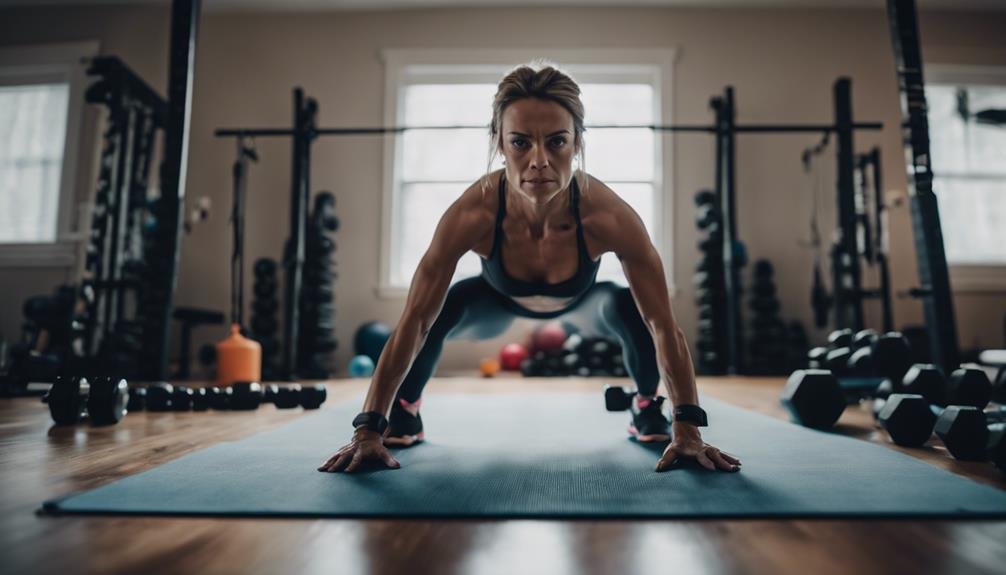
We're building a thorough home fitness routine that yields impressive full-body strength gains from the comfort of our own homes. A well-designed gym space with multi-functional equipment, a high-quality exercise mat, and proper safety precautions sets us up for success. We're focusing on compound exercises like squats, push presses, and lunges that engage multiple joints and muscle groups simultaneously. We'll also incorporate high-intensity interval training (HIIT) and resistance band workouts to boost our cardiovascular health and endurance. As we progress, we'll learn how to overcome plateaus, track our progress, and stay motivated to achieve our fitness goals – and there's more to come as we continue on this fitness journey.
Key Takeaways
- A well-designed home gym with multi-functional equipment, such as adjustable dumbbells and resistance bands, saves space and reduces clutter.
- Incorporate compound exercises like squats, deadlifts, and bench press to work multiple muscle groups simultaneously.
- Focus on exercises that target major muscle groups, such as the Push Press, Dumbbell Rows, and Incline Dumbbell Press.
- Incorporate HIIT workouts, which are short, efficient, and burn calories at an incredible rate, improving cardiovascular health and endurance.
- Create a workout plan with 3-4 sets of 8-12 reps for each exercise, incorporating rest days to allow muscles to recover and rebuild.
Building a Home Gym Essentials
We start building our home gym with the essentials, a carefully curated selection of equipment that will help us achieve our full-body strength goals. When it comes to gym aesthetics, we want a space that's not only functional but also visually appealing. We choose equipment with a sleek design that complements our home's decor. A well-designed gym space can boost our motivation and make working out a more enjoyable experience.
To optimize our space, we consider the layout carefully. We prioritize multi-functional equipment that serves multiple purposes, such as adjustable dumbbells and resistance bands. This not only saves space but also reduces clutter. We also invest in a high-quality exercise mat that provides ample grip and cushioning. By maximizing our space, we can fit in a variety of exercises and workouts, making our home gym a versatile and effective space for achieving our fitness goals. With careful planning and attention to detail, we can create a home gym that's both functional and beautiful.
Warm Up Exercises for Beginners
As we begin our full-body strength workout journey, a proper warm-up is essential to get us moving safely and effectively. We'll start by loosening up our muscles with some dynamic stretches to prevent injuries and improve flexibility. By incorporating these simple exercises into our routine, we're aware that we'll be able to tackle our workout with confidence and energy.
Get Moving Safely
Before diving into a full-body strength workout, let's get our bodies ready with a dynamic warm-up that will reduce the risk of injury and get our hearts pumping. As we prepare to move, we need to create a safe space for ourselves to exercise. This means clearing any tripping hazards, finding a flat surface, and having a water bottle nearby. Injury prevention is key, so let's take a few minutes to get moving safely.
Here are some essential warm-up exercises to get us started:
| Exercise | Description |
|---|---|
| Marching in place | Get those legs moving and warm up those muscles |
| Arm circles | Loosen up those shoulders and get the blood flowing |
| Leg swings | Get those hips moving and ready for action |
Loosen Up Muscles
Let's loosen up our muscles with six essential warm-up exercises specifically designed for beginners, which will get our blood flowing and prepare our bodies for a full-body strength workout. Before we begin, it's essential we take a few minutes to relax our muscles and relieve tension. This will not only prevent injuries but also enhance our overall performance.
We'll start with some light cardio, like jogging in place or jumping jacks, to get our hearts beating and warm up our major muscle groups. Next, we'll move on to some dynamic stretches, such as arm circles and leg swings, to loosen up our joints and muscles. These exercises will help increase blood flow, reduce muscle stiffness, and promote muscle relaxation. By incorporating these simple yet effective warm-up exercises into our routine, we'll be able to tackle our full-body strength workout with confidence and energy. By releasing tension and promoting muscle relaxation, we'll be ready to take on the challenges ahead and achieve our fitness goals.
Start With Stretching
We're starting with stretching exercises that target our major muscle groups, including our neck, shoulders, and back, which tend to hold the most tension. As beginners, loosening up these areas is crucial to prevent injuries and improve flexibility gains.
Before we embark on strength training, let's focus on mindful breathing and gentle stretches to awaken our muscles. This warm-up routine will help increase blood flow, reduce muscle soreness, and prepare us for the workout ahead.
Neck stretch: Slowly tilt our head to the side, bringing our ear towards our shoulder, and hold for 30 seconds.
Shoulder rolls: Roll our shoulders forward and backward in a circular motion to release tension.
Chest opener: Stand in a doorway with our hands on the doorframe at shoulder height, leaning forward until we feel a stretch in our chest and shoulders.
Hip circles: Stand with our feet shoulder-width apart, moving our hips in a large circle, first clockwise and then counterclockwise.
Upper Body Strength Exercises
We target our chest, shoulders, and triceps with a variety of exercises that work multiple joints and muscle groups simultaneously, maximizing our upper body strength gains. By incorporating compound exercises, we can build strength and muscle mass more efficiently. One of our go-to exercises is the Push Press, which engages our shoulders and triceps as we press dumbbells overhead. We also love Dumbbell Rows, which hit our back and shoulder muscles simultaneously. These exercises allow us to lift heavier weights and stimulate more muscle growth. Additionally, we incorporate exercises like Incline Dumbbell Press, Lateral Raises, and Tricep Extensions to facilitate a well-rounded upper body workout. By focusing on compound exercises, we can build a strong and defined upper body in the comfort of our own homes. With consistent effort and progressive overload, we can achieve impressive strength gains and a more toned physique.
Effective Lower Body Workouts
Building on our upper body strength, we now turn our attention to the lower body, where powerful legs and glutes form the foundation of overall athletic performance and everyday functionality. A strong lower body is essential for balance, stability, and overall mobility.
A strong lower body is essential for balance, stability, and overall mobility.
Squats: Works multiple leg muscles, including quadriceps, hamstrings, and glutes. Stand with feet shoulder-width apart, then bend knees and lower body down until thighs are parallel to ground.
Calf raises: Targets calf muscles, which are essential for ankle strength and stability. Stand on edge of a step or curb with heels hanging off, then raise up onto tiptoes and lower back down.
Hamstring curls: Isolates hamstring muscles, which are vital for knee flexion and hip extension. Lie on floor with legs straight, then bend knees and lift heels towards glutes.
Lunges: Works quadriceps, hamstrings, and glutes, as well as improves balance and coordination. Stand with feet together, take a large step forward, and lower body down until back knee almost touches ground.
Core Strengthening Exercises at Home
With a strong lower body in place, we can now focus on developing a robust core that will enhance our overall athletic performance and everyday functionality. A strong core provides stability, balance, and power, making it an essential component of full-body strength workouts. We'll explore some effective core strengthening exercises that can be done from the comfort of our own homes.
Core engagements are a great way to target our abdominal muscles. By engaging our core, we can improve our posture, reduce lower back pain, and enhance our overall athletic performance. Pelvic tilts are another effective exercise for strengthening our core. This exercise targets our transverse abdominis muscle, which is essential for stabilizing our spine and pelvis.
Here are some core strengthening exercises we can do at home:
| Exercise | Targets | Reps |
|---|---|---|
| Plank | Core, Abs | 3 sets of 30-60 seconds |
| Pelvic Tilts | Transverse Abdominis | 3 sets of 10-15 reps |
| Russian Twists | Obliques | 3 sets of 10-15 reps |
| Leg Raises | Lower Abs | 3 sets of 10-15 reps |
| Bicycle Crunches | Obliques | 3 sets of 10-15 reps |
Bodyweight Exercises for Beginners
Now that we've established a strong core, let's focus on exercises that work multiple muscle groups simultaneously, starting with bodyweight exercises perfect for beginners. These exercises are a great way to continue our fitness journey, and they require minimal equipment, making them perfect for a home workout.
As we start our bodyweight exercises, having a workout accountability system in place is crucial. This can be achieved by finding a workout buddy, joining a fitness group, or tracking our progress on a fitness app. Having someone to hold us accountable will help us stay motivated and consistent.
Here are some bodyweight exercises perfect for beginners:
- Squats: Works quadriceps, hamstrings, and glutes
- Push-ups: Targets chest, shoulders, and triceps
- Lunges: Works quadriceps, hamstrings, and glutes
- Planks: Engages core, shoulders, and back muscles
These exercises will help us build strength, increase flexibility, and boost our overall fitness. By incorporating these exercises into our routine, we'll be well on our way to achieving our fitness goals and maintaining a consistent workout routine.
Resistance Band Workouts at Home
We can take our workouts to the next level by incorporating resistance band exercises into our routine, which offer an effective and space-saving way to strength train at home. One of the biggest advantages of resistance bands is their portability – we can take them with us wherever we go, making it easy to fit in a workout even when we're short on time or space.
| Workout Variation | Muscle Groups Targeted |
|---|---|
| Chest Press | Chest, Shoulders, Triceps |
| Banded Squats | Legs, Glutes, Core |
| Lateral Raises | Shoulders, Back |
With resistance bands, we can target multiple muscle groups at once, making them an efficient addition to our home workout routine. Plus, they're affordable and take up minimal storage space, making them a great option for those with limited space at home. By incorporating resistance band exercises into our routine, we can increase the intensity and variety of our workouts, leading to faster progress and better results.
High-Intensity Interval Training
High-intensity interval training (HIIT) blasts our metabolism into overdrive, igniting a firestorm of fat-burning potential that can torch calories long after our workout is complete. This type of cardio blast is a game-changer for those looking to maximize their fat-burning potential in a short amount of time. By incorporating HIIT into our fitness routine, we can expect increased caloric expenditure, improved cardiovascular health, and enhanced athletic performance.
Here are just a few reasons why we love HIIT:
- Efficient: HIIT workouts are typically short, lasting anywhere from 15-30 minutes, making them perfect for busy schedules.
- Calorie-torching: HIIT has been shown to burn calories at an incredible rate, both during and after exercise.
- Improved cardiovascular health: HIIT workouts are designed to push our hearts to work harder, improving cardiovascular health and increasing endurance.
- Metabolic boost: HIIT has been shown to increase our resting metabolic rate, helping us burn more calories at rest.
Full-Body Workout Routines for Women
As we shift our focus from cardio-based workouts to strength training, we're going to explore full-body workout routines that cater specifically to women's fitness needs. Female empowerment through fitness is all about embracing body positivity and celebrating our unique strengths. A well-rounded full-body workout routine can help women build confidence, boost self-esteem, and develop a more positive body image.
Here are some exercises that are perfect for women's full-body strength training:
| Exercise | Muscle Group |
|---|---|
| Squats | Legs, Glutes, Core |
| Push-ups | Chest, Shoulders, Triceps |
| Lunges | Legs, Glutes, Core |
| Chest Press | Chest, Shoulders, Triceps |
These exercises target multiple muscle groups at once, making them efficient and effective for women who want to get fit and strong at home. By incorporating these exercises into our workout routines, we can build strength, confidence, and a more positive body image. As we focus on our fitness journey, we're not just building stronger bodies – we're building a stronger sense of self.
Home Workout Plans for Men
Men's fitness goals often revolve around building lean muscle mass, boosting testosterone levels, and increasing overall strength, making a well-structured home workout plan essential for achieving these objectives. As we focus on masculine fitness, we recognize that a consistent and well-planned workout routine is vital for achieving our fitness goals.
To maintain workout consistency, we recommend incorporating exercises that target multiple muscle groups at once. This not only saves time but also helps in building overall strength. This approach will help you:
- Focus on compound exercises like squats, deadlifts, and bench press that work multiple muscle groups at once
- Incorporate HIIT (High-Intensity Interval Training) workouts to boost testosterone levels and increase calorie burn
- Aim to do 3-4 sets of 8-12 reps for each exercise to build lean muscle mass
- Make sure to include rest days in our workout plan to allow our muscles to recover and rebuild
Creating a Customized Fitness Plan
We're now ready to take our fitness goals to the next level by crafting a customized fitness plan that accounts for our unique needs, goals, and preferences. This plan will serve as our roadmap to achieving our desired physique and overall well-being.
To create an effective plan, we need to examine our fitness goals, workout philosophy, and available resources. Here's a breakdown of the key factors to factor in:
| Category | Description | Examples |
|---|---|---|
| Fitness Goals | What do we want to achieve? | Weight loss, muscle gain, increased endurance |
| Workout Philosophy | How do we want to work out? | Bodyweight exercises, weightlifting, high-intensity interval training (HIIT) |
| Available Resources | What resources do we have access to? | Home gym, outdoor spaces, fitness classes |
Overcoming Plateaus at Home
As we work on our full-body strength workouts at home, we've all experienced it – that frustrating plateau where progress seems to stall. We're aware that breaking through this stagnation is crucial, and that's exactly what we'll cover next. We'll explore breakthrough stagnation strategies and progressive overload techniques to help us overcome plateaus and continue making gains.
Breakthrough Stagnation Strategies
Stuck in a rut, we've all been there – hitting the same old weights and reps, yet seeing little to no progress. It's frustrating and demotivating, but don't worry, we've got some strategies to help us break through the stagnation.
To overcome plateaus, we need to shake things up and challenge ourselves in new ways. Here are some breakthrough stagnation strategies to get us back on track:
- Mindset reset: Take a step back, reassess our goals, and remind ourselves why we started this fitness journey in the first place.
- Goal recalibration: Re-evaluate our goals and set new, specific, and achievable targets to work towards.
- Change up our routine: Try new exercises, workout schedules, or even take a break from our usual routine to come back stronger.
- Get accountability: Find a workout buddy, hire a personal trainer, or join a fitness community to stay motivated and inspired.
Progressive Overload Techniques
To overcome plateaus, we need to progressively challenge our muscles, and that's where progressive overload techniques come in – a game-changer for making gains at home. By incrementally increasing the intensity of our workouts, we can avoid stagnation and continue to make progress. One effective way to do this is through micro progressions, which involve making small, incremental changes to our exercises over time. This can be as simple as adding a rep or set, increasing the weight, or changing our grip or stance. Another key strategy is load variation, which involves changing the weight or resistance we're using to challenge our muscles in different ways. By incorporating these techniques into our workouts, we can continue to push ourselves and make gains, even when working out from home. The key is to be intentional and strategic in our approach, making gradual changes that allow us to continue challenging ourselves and making progress. With progressive overload techniques, we can break through plateaus and achieve our fitness goals.
Safety Precautions for Home Workouts
We must prioritize safety when working out at home to avoid preventable injuries that can derail our fitness progress. As we embark on our home workout journey, it's essential to identify and mitigate potential risks that can lead to injuries. Our homes can be filled with hazards that can hinder our progress, from slippery floors to poorly lit workout areas.
To ensure a safe and effective workout, we need to take the following precautions:
- Clear the workout area: Remove any tripping hazards, such as cords, rugs, or clutter, to create a clear and safe workout space.
- Invest in workout insurance: Consider investing in workout insurance that covers home workouts, providing financial protection in case of an injury.
- Use proper equipment: Ensure that our workout equipment is in good condition and properly maintained to avoid any malfunctions.
- Warm up and cool down: Always warm up before our workout and cool down afterwards to prevent muscle strains and injuries.
Tracking Progress and Staying Motivated
As we commit to our home workout routine, regularly tracking our progress helps us stay motivated and focused on our fitness goals. By monitoring our progress, we can identify what's working and what areas need improvement. We can use a workout log or mobile app to track our exercises, sets, reps, and weight lifted. This helps us see how far we've come and makes adjustments to our routine more effective.
Setting specific, measurable, and achievable goals is also essential in staying motivated. We should set both short-term and long-term goals, breaking them down into smaller, manageable tasks. This helps us stay focused and motivated, as we work towards our desired outcomes. Additionally, incorporating mindfulness practices, such as meditation and deep breathing, can help us stay present and focused during our workouts. By combining goal setting with mindfulness, we can cultivate a stronger mind-body connection, leading to a more effective and sustainable fitness journey. By tracking our progress and setting achievable goals, we can stay motivated and committed to our home workout routine.
Frequently Asked Questions
Can I Do Full-Body Workouts at Home With No Equipment at All?
We can definitely do full-body workouts at home with no equipment at all; bodyweight exercises like push-ups, squats, and lunges are effective for building strength and improving home fitness.
How Often Should I Rest Between Exercises and Sets at Home?
We're not superhumans, so we need rest. Aim for 30-60 seconds between sets and 60-120 seconds between exercises to avoid exercise fatigue. That's the sweet spot for ideal rest duration, trust us!
Are There Any Full-Body Workouts Suitable for Seniors or Older Adults?
We recognize that age-related limitations can impact senior fitness goals, so we recommend low-impact, modified exercises that prioritize flexibility and balance, incorporating chair support and shorter exercise intervals to facilitate safety and accessibility.
Can I Do Full-Body Workouts at Home With a Busy Schedule?
"Who has time, right? But seriously, we can squeeze in full-body workouts at home even with a crazy schedule. We prioritize our fitness goals, manage our time wisely, and get creative with 10-15 minute sessions that pack a punch!"
Are Full-Body Workouts at Home Effective for Weight Loss?
We find that, yes, full-body workouts at home can be effective for weight loss, as they boost caloric expenditure and allow for progressive overload, helping us shed pounds and build lean muscle.
Conclusion
As we close this fitness journey, remember that our bodies are temples, and a strong foundation is key to tapping our full potential. Just as a tree's roots grow deeper with each storm, our bodies adapt to challenges, becoming stronger with each workout. By committing to these full-body strength workouts at home, we'll be unshakeable, like a tree that's weathered every storm, standing tall and proud, ready to take on whatever life throws our way.